
4 AI Keyword Research Generators to Complement Your Existing Process

Chelsea Frost
Content Strategist
Content Strategist
You know how it goes: keyword research is an absolute must when it comes to content strategy. Nail the right keywords, and you’re golden - your content will rank high and bring you conversions, driving valuable organic traffic.
AI keyword research generators have been blowing up lately. These tools use machine learning in different ways to analyze search data and give you a relevant keyword list. Plus, the best ones go beyond just keywords with cool extras like keyword grouping, search volumes, and even content brief generation.
But there are so many AI keyword generators out there that it’s hard to pick the right one. Some are super basic, while others are overengineered messes. Lots have crazy high price tags too. And very few actually give you strategic guidance beyond just listing keywords.
I’ve picked 4 of the most useful AI keyword research generators (including Yahini) that aren’t just your average tools. Let’s go.
Disclaimer: At Yahini, we spend a ton of time testing, researching and using various tools to figure out which ones are worth recommending, evaluating them based on what they’re supposed to do and how well they meet our criteria. We do not accept payment for featuring a tool in our articles or linking to a site.
If you use tools like Ahrefs or Semrush for raw data but then spend hours in spreadsheets trying to make sense of it all, Yahini is a strategy-first content operations platform that makes the perfect complement to your process. Its Automated Keyword Research Agent automates the most time-consuming part: the strategy.
It works differently from other tools. Yahini’s unique power comes from its ability to first understand the substance of your business and the strategy of the SERPs. Instead of starting with a seed keyword, you start by giving it your business context. The Brand Intelligence Agent uses this to find keywords that are not just popular, but strategically vital for you.
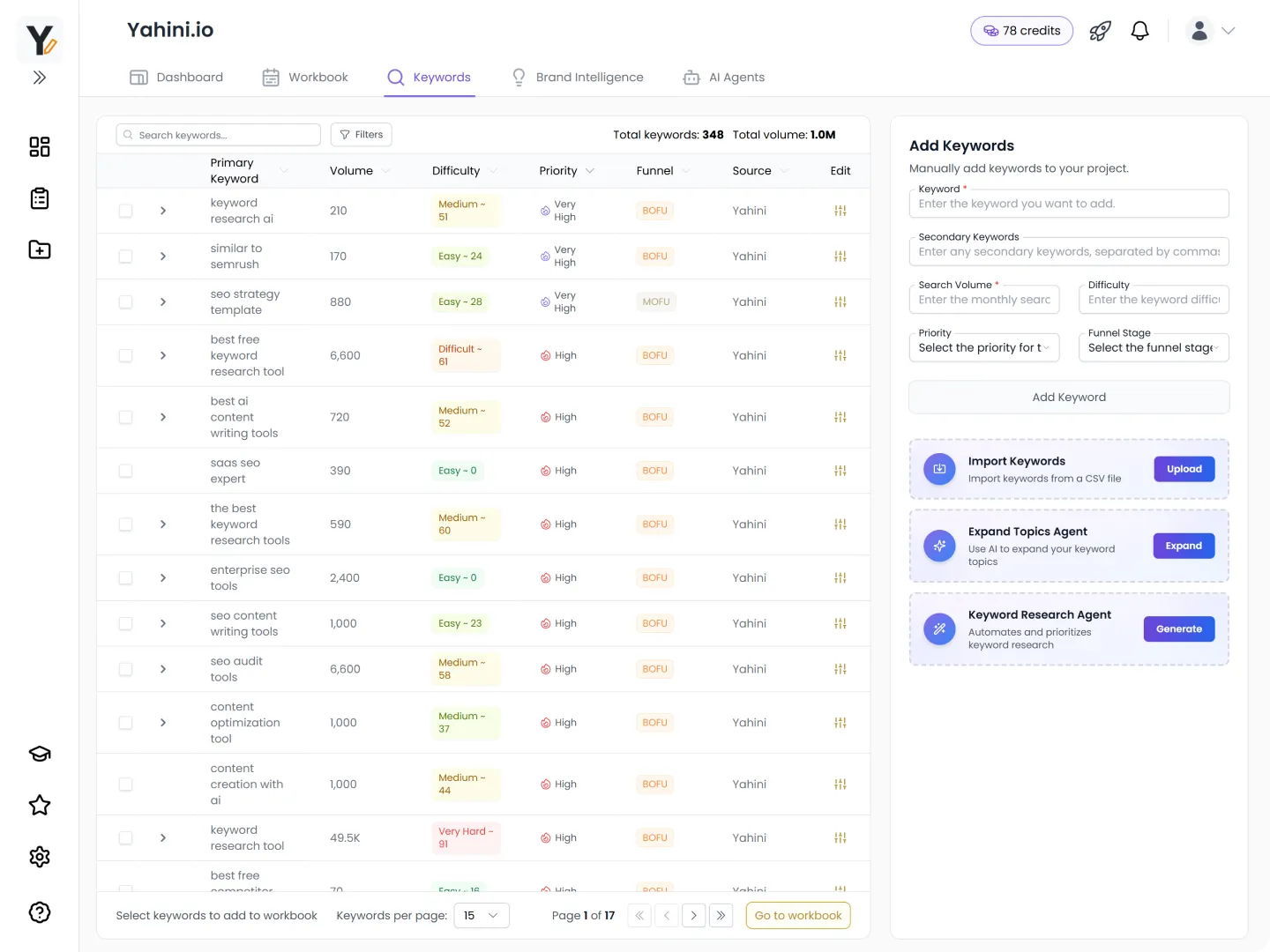
The result is a prioritized plan that complements your existing data with strategic direction.
Yahini handles the “grunt work” that strategists do after pulling their data, saving you time and adding a layer of AI-powered analysis:
Yahini is designed for marketers and founders who want to add a layer of automated strategic intelligence to their existing keyword research process. If you want to spend less time organizing keywords and more time executing a high-impact strategy, Yahini bridges that gap.
Here are other AI keyword tools that may appeal to different users and use cases – depending on what your exact goals are.
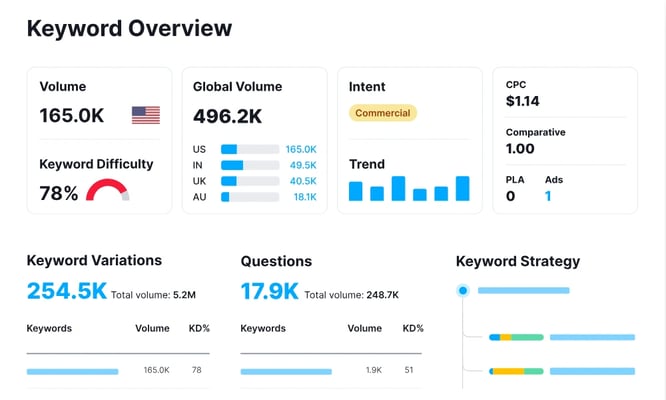
Semrush is one of the biggest players in the SEO world. Their whole platform is stacked with tools for keyword research, competitor analysis, site audits, you name it. It’s helpful for finding obscure long-tail keyword, and looking at what your competitors are ranking for. Many use it as a more advanced alternative to Google Keyword Planner.
However, it can be a bit complex if you’re just looking for an AI keyword research tool, especially if you’re new to SEO or just want a laser-focused keyword tool.
The Keyword Magic Tool is pretty slick though. Browse one of your target keywords or seed keywords and boom - Semrush spits out thousands of long-tail variations to explore.
You can dig into metrics like keyword difficulty, search volumes, even see which SERP features are showing up. It provides insights into monthly searches for specific search terms.
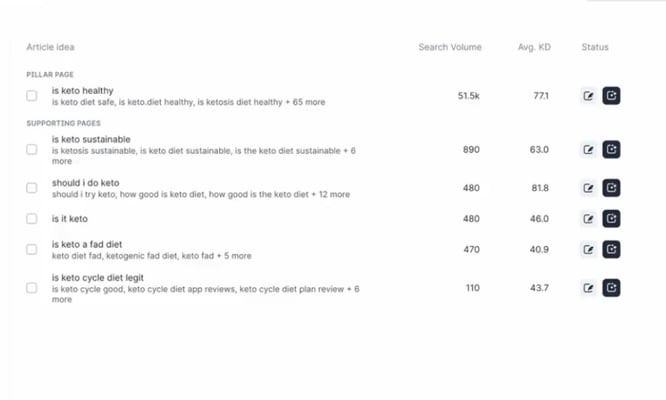
Surfer is an interesting one. It’s not just a keyword research tool - it’s an entire content optimization suite powered by AI. The keyword research side covers all the basics like uncovering relevant topics, checking search volumes and ranking difficulty.
Using AI, it can grade your draft content and provide optimization tips to better align with search intent. The Chrome extension for on-the-fly keyword lookup is great too.
That said, some users feel the core keyword research features are a bit basic compared to dedicated tools. If in-depth keyword analysis is your top priority, Surfer may leave you wanting more.
Surfer’s AI will analyze your draft content line-by-line and give you a grade based on how well it satisfies search intent for your target keyword. Then it provides specific recommendations to optimize things like word count, subheadings, semantic keywords - everything Google wants to see. This helps improve your overall SEO strategy.
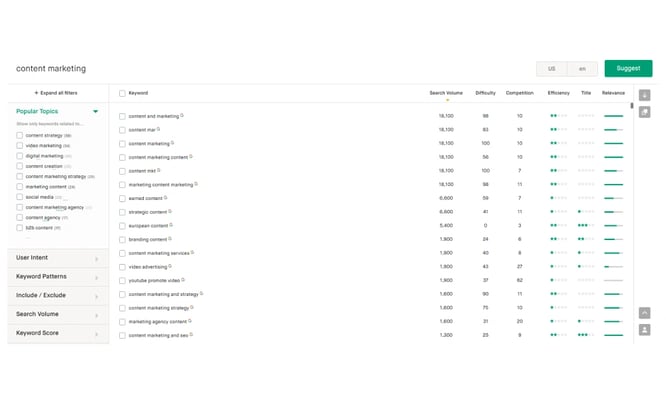
Twinword Ideas is a niche-focused keyword tool designed to uncover those obscure, relevant phrases in your specific industry. Instead of overwhelming you with millions of keywords to sift through, it uses AI to surface a more curated, high-opportunity selection.
For businesses hyper-focused on dominating a particular niche, this could be a solid tool. You can quickly build out your content strategy around those core topics and keywords that matter most, generating valuable keyword ideas.
I’m a big fan of the Keyword Grouping functionality in Twinword. Instead of staring at a messy jumble of keywords, the AI automatically categorizes them into logical topic groups and themes.
For example, if you sell yoga equipment, Twinword might group keywords like “yoga mats”, “eco-friendly yoga mats”, and “best yoga mats for beginners” together under a “Yoga Mats” theme. From there, it’s easy to map out blog posts, product pages, and other content assets to target those core topics.
Alright, so you’ve seen the options - but how do you decide which AI keyword tool is the right fit? The answer really depends on your specific needs and situation.
Some tools are better suited for larger teams and budgets, while others are better for smaller operations or niche businesses. Maybe you want a dedicated keyword tool, or perhaps an all-in-one platform with extra SEO goodies is more your vibe.
The good news? You don’t necessarily have to pick just one. Plenty of savvy marketers actually use multiple tools in tandem to get the best of all worlds. I’ll break down an easy evaluation framework to help you make that call.
When vetting AI keyword generators, ask yourself these 5 key questions:
When you weigh all those factors, you’ll likely find that Yahini checks most of the boxes. Its combination of AI power and human-guided strategy is ideal for teams who want a reliable, affordable, and easy-to-use keyword solution.
While there’s no shortage of AI keyword alternatives out there, Yahini stands apart as a strategy-first content operations platform with its:
Sure, other tools may have additional functionality for broader SEO needs. But if strategic keyword research and actionable content planning are your priorities, Yahini is tough to beat. Don’t just take my word for it - try it yourself.
Let’s tackle some of those burning questions you might have about Yahini and AI keyword tools in general:
Yahini takes a totally different approach as a strategy-first content operations platform. Its AI agents are trained on proven content strategy frameworks developed by actual human marketing strategists. So the keywords, content briefs, and recommendations you get are tailored, strategic assets that set your content up to crush it.
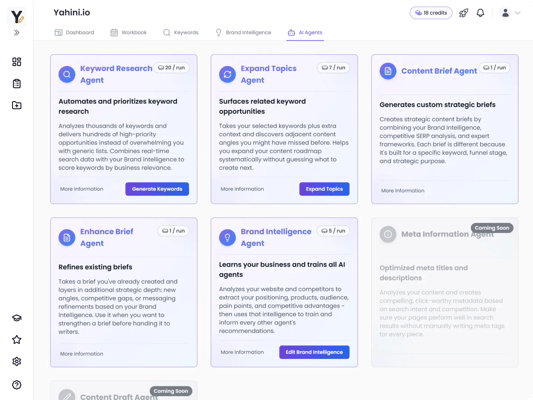
It’s stupid simple. Just enter your website URL and a few quick details about your business, competitors, target audience, and goals. Yahini then analyzes a ton of data points to identify the most relevant, high-impact keywords for your needs.
Yahini doesn’t just give you a messy list of keywords. It automatically categorizes and prioritizes them by factors like:
From there, you can select your priority keywords and funnel stages. Yahini will then autogenerate a full content strategy workbook and brief for each term you choose - all with the click of a button.
There’s no one-size-fits-all, but some key considerations are your primary use case, budget, team size, and depth of analysis needed. Many will compare features to those found in Google Keyword Planner.
For example, are you just looking for high-level keyword buckets to map content pillars? Or do you need ultra-granular clustering and analysis? What kind of strategic guidance and workflows do you need included?
It’s also important to assess the tool’s strengths in areas like:
This really depends on the specific tool and methodology used. Some AI keyword generators are little more than slightly smarter versions of Google’s Keyword Planner - they’ll give you decent high-level terms, but likely miss long-tail opportunities and deeper insights. These might not identify popular keywords with high keyword difficulty.
More advanced platforms like Yahini actually analyze a ton of data points beyond just basic keyword research, including:
The end result is a highly curated, accurate list of relevant keywords mapped to your unique business needs. Yahini has been tested against real human keyword research and consistently matches 90% of the same terms identified by experts.
Alright, you’ve seen the options. You likely haven’t 100% made up your mind, but it’s okay. You’ll probably need to trial a few of these tools and see which one works best. Remember to consider factors like the tool’s ability to identify seed keywords, analyze search queries, and help with your SEO efforts, including planning for PPC campaigns and other search campaigns.
Also, please note that this list is definitely not exhaustive. It’s just a small list of tools I’ve used and I can personally recommend. Do your own research and determine which one is best for you :)
Yahini, a strategy-first content operations platform, provides you with expert-level content briefs right at your fingertips. It identifies target keywords, analyzes monthly search volume, and assesses keyword difficulty. Yahini clusters SEO keywords to improve your content rank and overall organic traffic.
Streamline your keyword research into actionable content ops. See how Yahini can turn your keyword insights into strategic briefs and workflow management.
Ready to connect keyword research to execution? Try Yahini and generate your first prioritized keyword plan in minutes.
Any questions? I’m happy to help. Just reach out to us!
Not ready yet? Learn more about Yahini here.