Content strategy
Minimum Viable Authority: A Content Strategy for Businesses Built on Expertise

Maria-Cristina Muntean
Co-Founder / CMO

Table of Contents
For the first few years of my business, I believed a lie.
The lie was that my content calendar was a measure of my marketing success. I spent 15-20 hours a week in what I now call a content chaos cycle: brainstorming ideas, filling in calendars, and chasing engagement on social media. I was busy, but I wasn’t getting results.
The problem is that the traditional content marketing strategy playbook was designed for massive media companies, not for expert-founders like us.
The difference between content strategy (the tactical execution) and content marketing strategy (the business-aligned approach) is critical - and most founders confuse the two.
We can’t win by creating more. We win by being more precise.
After hitting a wall, I threw out the old playbook and built a new system from scratch, one that connected my expertise directly to revenue.
I call it Minimum Viable Authority (MVA). It’s all about doing less, but with extreme focus. It became the core philosophy behind the software we built at Yahini.

Why this model works: The strategy of constraint
The MVA model is built on a simple premise: your ideal customers are not looking for a library.
They have one specific, expensive problem, and they want the one person who can solve it better than anyone else.
Research from Edelman and LinkedIn shows that 64% of business decision-makers believe an organization’s thought leadership is a more trustworthy way to assess its capabilities than its marketing materials. They are actively looking for expertise.
These buyer personas represent different stages of the customer journey, from problem-aware prospects researching solutions to decision-ready executives evaluating vendors.
By focusing all your energy on a single problem, you become the most credible, trustworthy choice for those high-value buyers.
This approach works because it:
-
Aligns with search intent: People don’t search for “business strategy.” They search for “how to reduce customer churn in a SaaS business.” MVA targets these specific, high-intent queries while building organic search authority around your expertise.
-
Builds real authority, fast: For an expert, nothing is more frustrating than having your deep knowledge diluted into generic ‘content fluff.’ Spreading yourself thin makes you a jack-of-all-trades online, even if you’re a master offline. The MVA model forces you to plant your flag and dominate one high-value problem. It’s the fastest path to making your online reputation match your real-world expertise, attracting customers who seek a master, not a generalist.
-
Creates a strategic asset: Instead of a collection of disposable blog posts, you build an interconnected content “cluster” that becomes more valuable over time, driving leads for years. This content governance approach ensures every piece serves your broader business objectives.
The MVA mapping canvas
To execute this, you need a plan. I use a simple one-page template called the MVA Mapping Canvas to guide my strategy. It has three parts:
-
The High-Value Problem: Define the one problem you will own.
-
The Pillar Content: Outline your definitive guide to solving it.
-
The Spoke Content: List every related question you will answer.
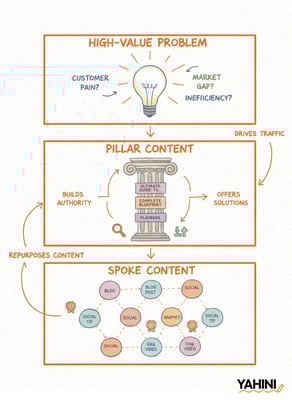
Before building your MVA Canvas, conduct a brief content audit of your existing materials and competitive analysis of key players in your space.
This foundation work prevents you from duplicating efforts and helps identify content gaps your competitors haven’t filled.
This canvas is your command center. Let’s walk through how to fill it out, step-by-step.
Step 1: Identify your high-value problem
This is the most critical step. Get this wrong, and the rest of the system fails.
This is where you apply what we at Yahini call True Business Understanding - the deep knowledge of what your customers actually care about. A high-value problem isn’t a topic; it’s a pain point that sits at the intersection of your expertise and your customer’s wallet.

The 3-part Litmus test for a high-value problem
Run your ideas through these three questions:
-
Is it urgent and specific? Can you picture your ideal customer typing this into Google in a moment of frustration?
-
Do you have a unique solution? Do you have a strong, defensible point of view on how to solve this? Your unique methodology is the core of your authority.
-
Is it directly tied to revenue? Is the person looking for this solution the person who has the authority and budget to buy from you? If not, it’s the wrong problem.
How to find your MVA problem
Stop guessing.
I interviewed five of my best customers and asked them two questions:
-
“What was the specific ‘I’m at my wits’ end’ moment that made you start searching for help?”
-
“What would have been the cost to the business of not solving that problem?”
These conversations also revealed detailed buyer personas - the specific roles, responsibilities, and pain points of decision-makers in my target market.
Understanding whether you’re speaking to a VP of Marketing worried about lead generation, a CEO focused on customer acquisition costs, or a Director of Operations concerned with process efficiency changes everything about your content approach.
The patterns that emerge from these conversations are where you’ll find your MVA.
This deep understanding of your brand and customer is the foundation of a smart content strategy. It’s the exact kind of expert knowledge that Yahini’s Brand Intelligence Profile is designed to learn and codify, ensuring your strategy is built on what actually drives your business.
Step 2: Create the definitive pillar guide
Your pillar article is the anchor of your entire strategy. Its goal is to be the single best resource on the internet for your chosen problem.
I was terrified to publish my first one, thinking I was giving away the farm. I was. And it was the best decision I ever made.

Components of a pillar article:
A truly definitive guide is more than a wall of text. It must include:
-
A codified methodology: don’t just give tips. Give them your named, step-by-step process for solving the problem. This is what they’ll remember.
-
Actionable steps and tools: show them how to do it. Mention specific tools (like Ahrefs for research or Figma for mapping) that help execute your process.
-
Real-world examples: use mini-case studies from your own experience or from well-known companies to illustrate your points.
-
Visual aids: include diagrams, checklists, or a walkthrough of your MVA canvas to make complex ideas easy to grasp.
-
SEO structure and keyword research: your pillar content should target your primary keyword while naturally incorporating related terms your audience searches for. Use proper heading hierarchy (h1, h2, h3) and internal linking to signal topic authority to search engines.
You are outlining this entire piece in Column 2 of your canvas.
The goal is to create a resource so valuable that your ideal customer bookmarks it, shares it with their team, and immediately views you as the expert.
Step 3: Build your spoke content cluster
With your pillar defined, you can now build a moat of supporting content around it.
These are your “spoke” articles. Each spoke is a shorter, 750-1,000 word article that answers a single, highly-specific question related to your MVA problem.
This is the part of the strategy that directly reflects Yahini’s principle of Smart Funnel Alignment.
Your pillar article attracts people who are deep in the research phase (Middle of Funnel), while your spoke articles capture people asking very specific questions at all stages of their journey (Top and Middle of Funnel).
Different content types - from quick-answer blog posts to comprehensive guides to downloadable templates - serve different points in the marketing funnel and buyer’s journey.
How to find spoke topics without guessing
Your customers are telling you exactly what to write about. You just have to know where to look.
-
Google’s “People Also Ask”: Type in your high-value problem and see what questions Google surfaces.
-
AnswerThePublic: A great tool for visualizing all the questions people ask around a core topic.
-
Community forums: Search for your topic on Reddit, Quora, and industry-specific forums. The questions people ask there are raw, unfiltered, and perfect for spoke content.
For every spoke article, you must do two things: provide a complete and direct answer to the question, and link back to your main pillar guide. This creates a powerful network of internal links that signals to search engines that your pillar is the central hub of authority on this topic.
Your content creation process should include a standardized workflow:
keyword research → outline creation → writing → internal linking → promotion.
This systematic approach ensures consistency and prevents the content chaos that plagues most businesses.
Manually researching, prioritizing, and mapping all these questions to a central pillar is exactly the kind of high-effort strategic work that causes founders to give up.
Step 4: MVA is a system, not a project
You now have a complete MVA plan on your canvas. But publishing the content is just the beginning. Your MVA cluster is a strategic asset that you must maintain.

-
Promote your pillar: don’t just “Share” it. Use it as a definitive answer in online communities. Send it to new prospects as a “Welcome gift” that shows your value.
-
Create an editorial calendar: plan your spoke content publication schedule 90 days in advance. This prevents the panic of “What should I write this week?” and ensures consistent momentum toward your business goals.
-
Measure what matters: forget vanity metrics like traffic. Track SMART goals that connect to revenue: qualified leads generated, discovery calls booked, conversion rates from content to customers, and customer lifetime value of content-sourced leads. Did the people who read your pillar article eventually become customers?
-
Update and expand: once a quarter, review your content cluster. Can you add a new spoke? Can you update the pillar with a new case study or tool?
Your next step: from overwhelmed to authoritative
The content chaos cycle will keep you busy forever. It will drain your time, your energy, and your confidence.
The MVA playbook is your way out. It’s a focused, repeatable system for turning your hard-won expertise into a predictable source of high-value customers. This content marketing strategy aligns your expertise with clear business objectives, turning content creation from a cost center into a revenue driver.
Stop staring at a blank calendar. Take 30 minutes today and define your high-value problem.
-
Need a strategy-first content operations platform? See how Yahini can help you craft perfect content briefs.
-
Any questions? I’m happy to help! Just reach out on LinkedIn.
-
Not ready yet? Learn more about Yahini here.
That one small act of strategic focus is the first step to building a business where you are not the bottleneck. You are the engine.