
5 Best AI SEO Tools To Grow Your Expert-Driven Business

Maria-Cristina Muntean
Co-Founder / CMO
Co-Founder / CMO
As a founder, your expertise is your most valuable asset. But how do you scale it into an AI SEO strategy that builds authority and drives a consistent flow of leads? You have the knowledge, but not the hours in the day or a clear process to turn it into organic traffic and establish topical authority in your niche.
The thing is, 86% of SEO professionals have integrated AI into their workflow. However, this is still a core challenge for expert-driven businesses.
The rise of AI in SEO promises a solution, but it has also created a lot of noise. With the emergence of AI Overviews, ChatGPT visibility, and generative engine optimization (GEO), the SEO landscape has fundamentally shifted beyond traditional Google rankings.
Traditional SEO often involves manual, time-consuming research. AI SEO uses technology to accelerate that work through automated keyword research, content optimization, and technical SEO audits.
But let’s be clear: AI is not a magic wand for rankings. The principles of great SEO have not changed. It is still about creating valuable, expert-driven content for a specific reader that demonstrates E-E-A-T (Experience, Expertise, Authoritativeness, Trustworthiness).
This article is a guide for founders to find AI SEO tools that help them strategically apply their expertise, not replace it. These are the tools that help you make smarter decisions, faster while maintaining your unique brand voice and perspective.
Here’s the thing everyone gets wrong about AI in SEO: its real job is to automate strategy, not just writing. Modern AI SEO encompasses everything from content creation and internal linking optimization to tracking your visibility in AI search engines like Perplexity and ChatGPT.
For a business like yours (and mine), authority is everything. The moment your content starts sounding generic, you’ve lost. Your content needs to rank not just on Google, but also appear in AI search results where your prospects are increasingly finding answers.
The biggest risk with AI is that it lures you into producing soulless content that dilutes your brand and erodes the very trust you’ve worked so hard to build.
A great SEO strategy always comes down to creating the right content for the right people. This means understanding search intent, optimizing for featured snippets, and building content clusters that establish your topical authority.
AI SEO tools should be your strategic partner in this. They should handle the grunt work - the keyword research, the topic planning, the competitive analysis.
This frees you up to do the one thing the machine can’t: inject your unique perspective and hard-earned wisdom into the actual content.
I’m one of the co-founders of Yahini, so of course, I’m biased. But I’m also going to be brutally honest about what it does and who it’s for, because we built it to solve the exact problem I’ve been describing.
I was tired of SEO tools that gave me massive spreadsheets of data but no clear direction. Yahini isn’t an AI writer; it’s a strategy-first content operations platform that turns your business goals into a prioritized SEO and content plan.
Teams of marketers and experts who believe their unique knowledge is their moat and want a tool that builds their SEO strategy around that knowledge. It’s for people who want to focus on high-impact work, not get lost in keyword data.
In a nutshell, Yahini helps you go from website URL → keywords → content outlines and manage your entire content operations system from research to execution.
I’ll break down the features, but what’s more important is how they work together as a strategist-trained system.
This is what we call Yahini’s Three Layers of Strategic Intelligence.
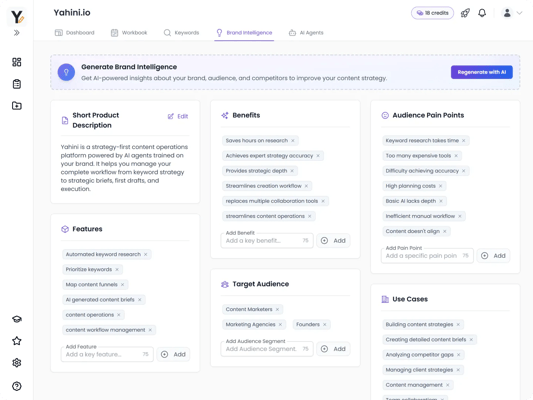
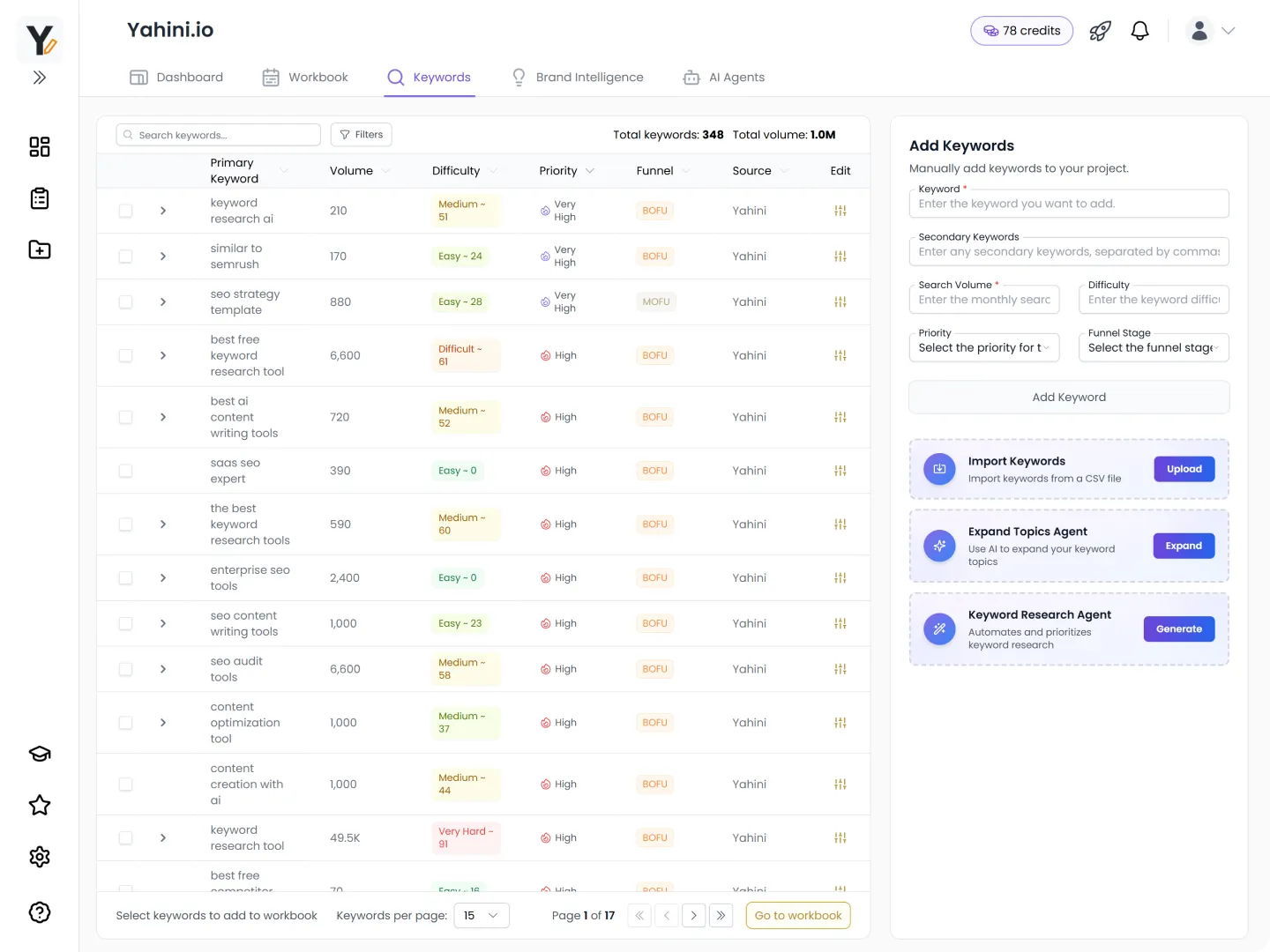
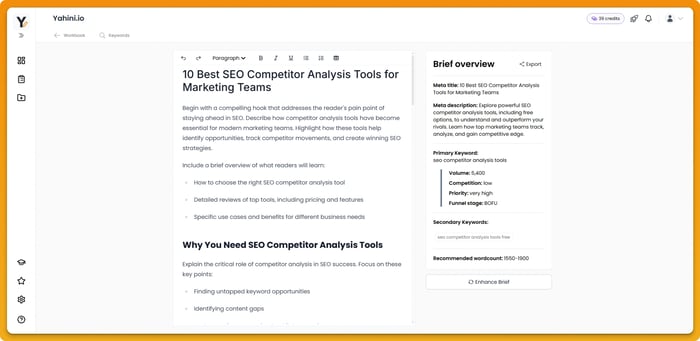
Yahini doesn’t currently track AI search visibility in ChatGPT or Perplexity, which is becoming increasingly important for brand monitoring.
Plans start at $39 per month and scale based on the number of AI credits you choose.
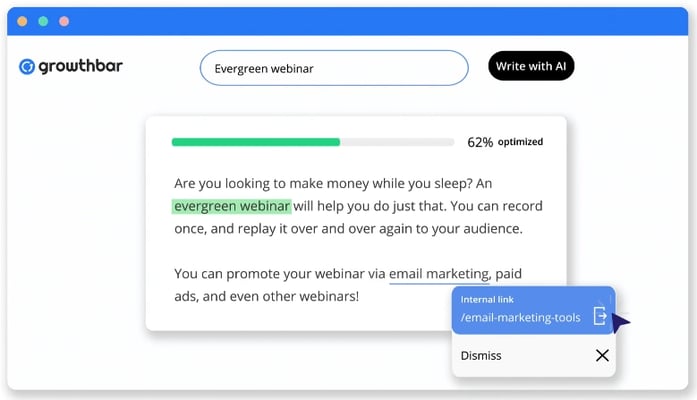
I’ve used GrowthBar, and it’s slick for a certain kind of workflow. It’s designed for speed, helping bloggers and marketers go from a single keyword to a drafted blog post as quickly as possible. It’s very much a tactical tool with solid content optimization features.
Founders or solo marketers who want to rapidly draft blog posts based on competitive research for one keyword at a time. It’s for when you already know exactly what you want to write about and just need to get it done while ensuring proper keyword optimization and content structure.
Its main feature is the “Content Outline Generator.” I’ve found this to be legitimately useful.
It scans the top-ranking articles for a keyword and creates an outline with headings, subheadings, and keyword suggestions. It gives you a good look at how your competitors are structuring their posts and identifies content gaps you can exploit for better ranking potential.
It also has a built-in AI writer to draft content based on that outline with automated internal linking suggestions and content optimization recommendations.
The problem, for a founder, is that GrowthBar doesn’t help you decide what to write about in the first place or why. It operates on a keyword-by-keyword basis. It lacks advanced features like content clustering, topical authority mapping, or AI search visibility tracking.
Also, the strategic thinking - connecting content to business goals, prioritizing topics, building authority - is still a completely manual process you have to do on your own.
GrowthBar’s pricing starts at $36 per month.
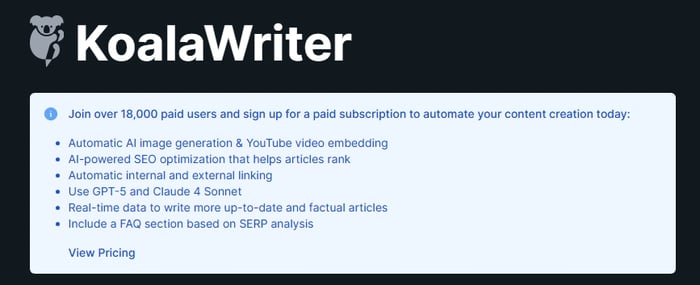
KoalaWriter has a great reputation among folks who need to produce a high volume of content, like affiliate marketers and niche site builders.
It’s a pure AI writer, but it’s known for generating pretty high-quality, long-form articles because it uses real-time data from search results to inform its writing and includes advanced content optimization features.
Content teams or founders running informational or affiliate sites who need to produce a high volume of fact-based articles efficiently. If your model is volume and you’re targeting less competitive informational keywords, it’s a powerhouse for content creation at scale with built-in SEO optimization.
The “SERP-Powered Writing” is its standout feature. It uses live search data to make its articles more accurate and factually grounded than a standard AI writer that might just pull from its training data.
It also allows you to create a custom “Brand Voice” and runs on GPT-4, so the output quality is generally strong with automatic keyword research integration and content briefs generation.
Like other AI writers, KoalaWriter is an execution tool. It’s exceptionally good at the “how” of writing an article, but it offers zero guidance on the “what” or “why.” It also lacks advanced SEO features like technical audits, backlink analysis, or AI search visibility tracking.
You still need a completely separate process and, likely, other tools to develop the content strategy that you feed into KoalaWriter.
KoalaWriter has a flexible pricing model that starts at $9 per month and scales up based on the number of words you generate.
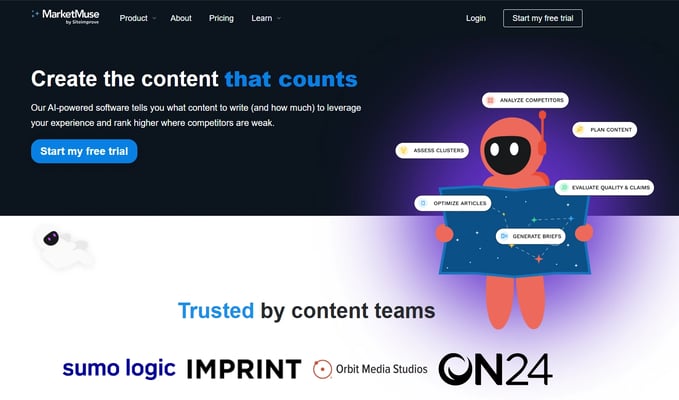
MarketMuse is a beast of a platform. It’s more of an enterprise-grade tool focused on content planning and optimization. It works by analyzing your entire website to map out your topical authority and show you where you have gaps. It’s very data-driven.
I’d say this is for established businesses with in-house marketing teams that already have a mature content program. It’s for when you’re looking to optimize and strategically expand an existing content library, not necessarily build one from scratch.
It gives you a “Personalized Difficulty” score for keywords, which is their way of telling you how hard it will be for you to rank, based on your current authority. This personalized keyword research approach is more accurate than generic difficulty scores.
The topic cluster analysis and competitive content analysis are also very powerful. It’s great for helping a team understand what they need to write to truly own a topic through strategic content optimization and internal linking strategies.
Honestly, the platform can be complex and overwhelming.
For a founder who is just trying to get a content engine off the ground, the sheer amount of data and features can lead to analysis paralysis. It’s built more for the expert SEO than for the business owner.
For those looking for different options, we’ve compiled a list of powerful MarketMuse alternatives.
MarketMuse offers custom enterprise pricing, but they do have a limited free plan you can use to get a feel for it.

Agility Writer is another strong AI writer, but it has a unique feature that I think is interesting: the “Topical Map Helper.” It’s designed to help you plan and create entire clusters of articles around a central topic.
SEO professionals and niche site builders who think in terms of “topic clusters.” If your strategy is to establish deep topical authority by publishing a dozen articles on a single subject, this tool is built for that workflow.
The “Topical Map Helper” is the star. It helps you generate a cluster of related article ideas, complete with entities and search intent, which you can then feed into a writer. This approach to content creation builds stronger topical authority and improves overall ranking potential.
The tool also has some advanced writing modes for creating very detailed articles and for optimizing a single article around a core keyword.
Its focus is still on an AI-first writing workflow.
While the clustering feature is a step toward strategy, it still requires you, the user, to have a strong sense of what your core topics should be. It helps organize production, but it doesn’t prioritize that production based on your actual business goals.
Agility Writer has plans starting from $25 per month and you can try it out for just $1.
You probably noticed some glaring omissions from this list.
Where’s Semrush? Ahrefs? Surfer?
These are the tools every other “best AI SEO tools” article leads with, and for good reason, they’re solid, established platforms with massive user bases.
But here’s the thing: if you’re running an expert-driven business, you don’t need another article telling you that Semrush has good keyword data. You already know that.
I deliberately focused on tools that solve the specific challenges founders face when trying to scale their expertise into content / SEO.
The big-name platforms are built for everyone, which means they’re optimized for no one in particular. They’ll give you all the data in the world, but they won’t tell you what to do with it in the context of your unique business model.
Popular tools we skipped and why:
Semrush - Excellent for agencies managing dozens of clients, but overkill for most founders who need strategic direction more than comprehensive data dashboards.
Ahrefs - Fantastic for content teams with dedicated SEO resources, but doesn’t solve the “what should I write about” problem that expert-driven businesses face.
Surfer SEO - Perfect for optimizing existing content, but operates at the page level rather than helping you build a cohesive content strategy around your expertise.
Frase - Great content optimization tool for established content operations, but requires you to already know your content priorities and topics.
ChatGPT for SEO - Incredibly powerful for ideation and editing, but requires significant SEO knowledge to prompt effectively; it won’t strategize for you.
Clearscope - Industry standard for content optimization, but it’s built for content teams with dedicated writers, not founders trying to systematically scale their expertise.
The hype around this stuff has created some really unhealthy expectations. Let me give you some straight talk.
This is the most dangerous myth out there. If you believe this, you’ll turn your brand into a commodity overnight. AI is a force multiplier, not a replacement. Your unique insights are the only thing that will make your content stand out.
Nope. AI automates tasks, it doesn’t automate thinking or quality control. You still have to own the strategy, review the briefs, and edit the final drafts. Your name is on it.
This includes ensuring proper content optimization, maintaining brand voice consistency, and conducting regular SEO audits to track performance.
This is a losing game. Ahrefs ran the numbers, and it’s bleak: over 90% of pages get zero traffic from Google. Publishing ten generic AI posts is less effective than publishing one fantastic, high-impact article that perfectly matches a customer’s need.
Google’s algorithms increasingly favor content that demonstrates genuine expertise and satisfies search intent, not just keyword optimization.
Quality and strategic intent are the only things that win in both traditional search results and emerging AI search platforms.
For a founder of an expert-driven business, it comes down to two things.
First, choose a tool that thinks like a founder. Does it connect your SEO work to business outcomes like leads and revenue? Or does it just give you vanity metrics like search volume? Your time is too valuable for the latter to waste on tactics that don’t directly impact growth and customer acquisition.
Second, make sure it’s built to capture and amplify your expertise. Your point of view is your brand. Your SEO tool should amplify it, not generalize it. Look for tools that support custom brand voice, maintain content optimization standards, and help you build genuine topical authority in your niche.
Ultimately, the best AI SEO tool is one that respects your expertise and automates your strategy, not just your writing. Lots of tools can create text. Very few can create a plan that connects content creation to business growth while maintaining the quality and authority your brand demands.
If this way of thinking resonates with you, I’d encourage you to check out what we’re building at Yahini. It was born from this exact philosophy. I’d be happy to show you how it can turn your expertise into a prioritized roadmap for attracting your ideal customers.